Gemini 3.6 Flash vs 3.5 Flash: Benchmarks, Pricing and When to Migrate (2026)
Gemini 3.6 Flash beats 3.5 Flash on every benchmark while cutting output tokens 17% and prices too. Full comparison tables plus a developer migration playbook.
A rare “strictly better” upgrade
Most model upgrades trade something away — quality for speed, price for capability. Gemini 3.6 Flash vs Gemini 3.5 Flash is the unusual case where the newer model wins on every axis Google published on July 21, 2026: higher benchmark scores, fewer output tokens, fewer reasoning steps and tool calls, and a lower price per token. This deep dive walks through the numbers, then gets practical: who should migrate, when, and what to re-test.
If you want the full three-model launch context first, start with our announcement overview.
Token efficiency: the headline nobody should skip
The single most consequential number in the release isn’t a benchmark score. On the Artificial Analysis Index, 3.6 Flash consumes 17% fewer output tokens than 3.5 Flash for equivalent work. On DeepSWE by Datacurve, Google observed reductions of up to 65%.
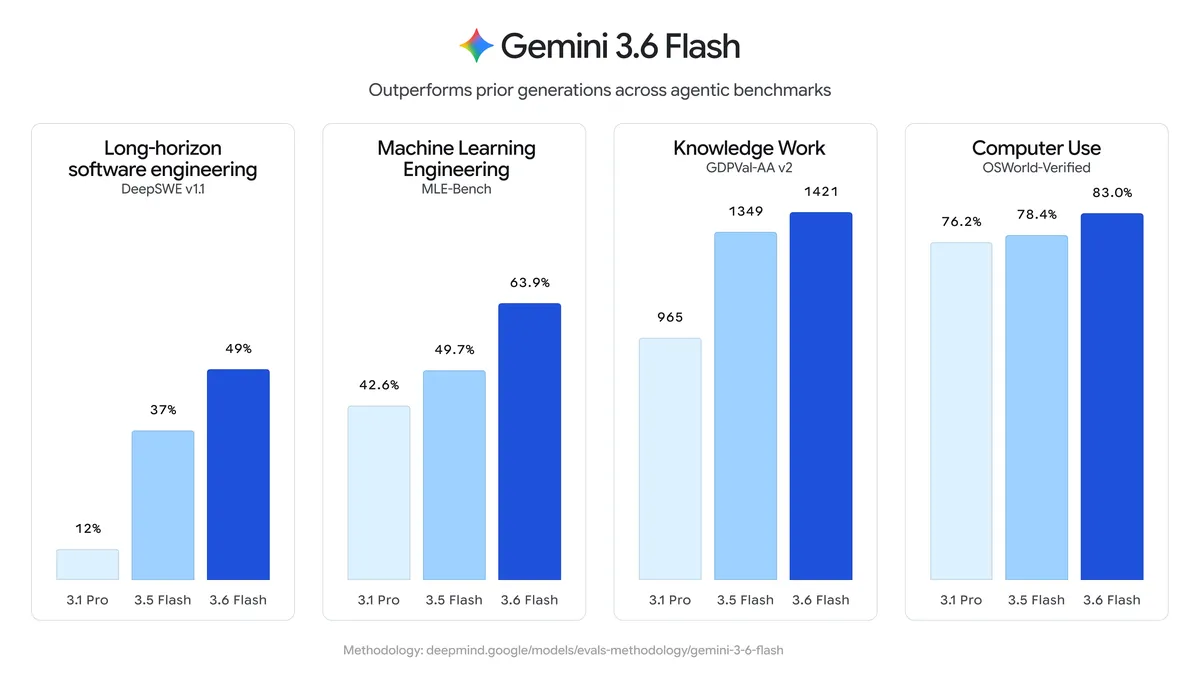
Why it matters more than it sounds:
- Output tokens are the expensive ones ($7.50/1M vs $1.50/1M input). Cutting them 17–65% attacks the dominant cost term.
- Fewer tokens = lower latency. An agent that says less finishes sooner, and multi-step chains compound the effect.
- Fewer reasoning steps and tool calls mean fewer round-trips, fewer failure points, and less orchestration overhead per task.
Google published a side-by-side demo of this on a computer-use task — see the token-efficiency comparison video.
Full benchmark comparison
| Benchmark | What it measures | Gemini 3.6 Flash | Gemini 3.5 Flash | Delta |
|---|---|---|---|---|
| DeepSWE | Agentic software engineering | 49% | 37% | +12 pts |
| MLE Bench | ML research & engineering | 63.9% | 49.7% | +14.2 pts |
| OSWorld-Verified | Computer use | 83.0% | 78.4% | +4.6 pts |
| GDPval-AA v2 | Real-world knowledge work | 1421 | 1349 | +72 |
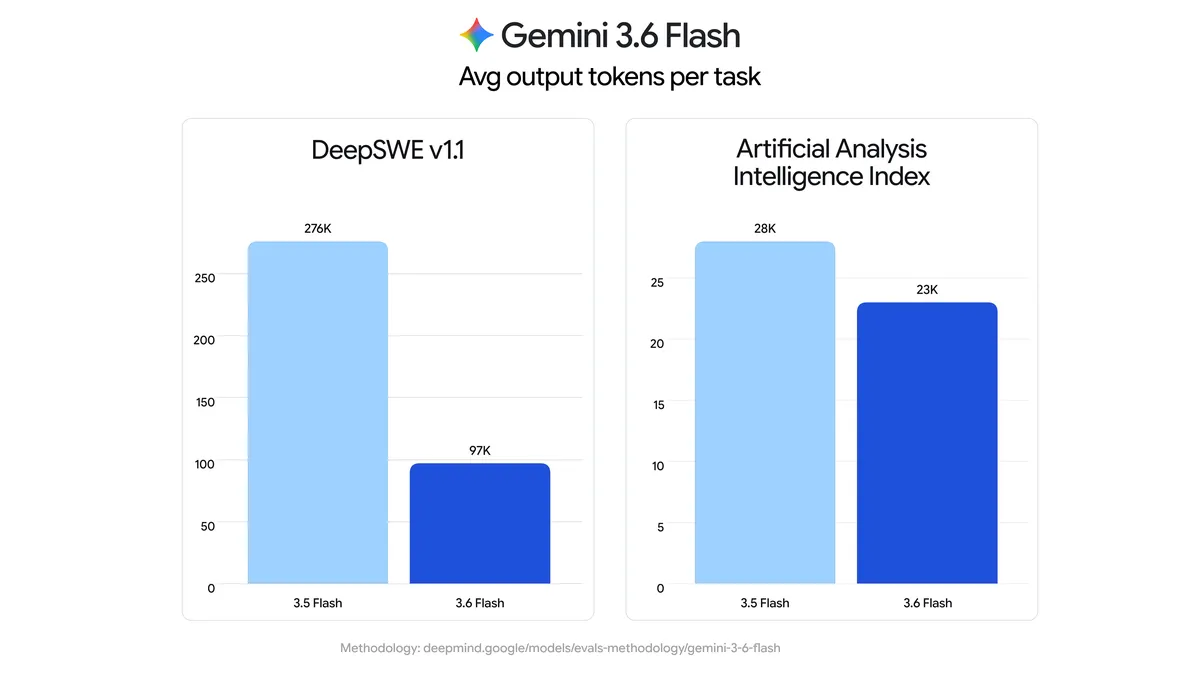
Three readings of the table:
- The DeepSWE jump (37% → 49%) is the one coding teams should care about: Google attributes it to higher precision — fewer unwanted code edits and reduced execution loops, not just more raw capability.
- MLE Bench (+14.2 points) is the largest gain, signaling a real step up in ML research workflows — experiment scaffolding, data analysis, training-loop debugging.
- OSWorld-Verified at 83.0% matters because computer use is now a built-in client-side tool in the Gemini API and Gemini Enterprise. The capability jump and the packaging change land together.
Pricing: cheaper per token, cheaper per task
| Gemini 3.6 Flash | Gemini 3.5 Flash | |
|---|---|---|
| Input price | $1.50 / 1M tokens | Higher |
| Output price | $7.50 / 1M tokens | Higher |
| Output tokens per task | ~17% fewer (up to 65% on DeepSWE) | Baseline |
| Effective cost per agentic task | Meaningfully lower | Baseline |
The compounding is the point. A task that used to emit 100K output tokens now emits ~83K, and each of those tokens costs less. For a workload running millions of agentic tasks per month, the savings show up on the invoice without touching your prompts.
Computer use: from add-on to built-in
With 3.6 Flash, computer use ships as a built-in client-side tool via the Gemini API and Gemini Enterprise. Combined with the OSWorld-Verified improvement (78.4% → 83.0%), teams building browser agents, RPA-style automation, or QA bots get both a stronger model and less integration code. If you previously maintained custom computer-use scaffolding around 3.5 Flash, plan to delete some of it.
Safety posture
3.6 Flash ships with enhanced Frontier Safety safeguards in the CBRN and cyber-offense domains, and Google reports it is substantially more jailbreak-resistant than 3.5 Flash. Just as relevant for product teams: it was also trained to reduce refusals on benign requests. If 3.5 Flash occasionally refused legitimate security-adjacent or medical-adjacent prompts in your product, re-test those flows — the false-refusal rate should drop.
What early customers say
Google’s launch list — Figma, Harvey, Hebbia, JetBrains — is worth decoding:
- Figma and JetBrains are tooling companies with latency-sensitive, high-volume inference: an endorsement of the speed/efficiency story.
- Harvey (legal) and Hebbia (finance) specifically praised multimodal document work: parsing, chart and data analysis, and report drafting. If your workload is document-heavy knowledge work, the GDPval-AA v2 gain (1349 → 1421) is your relevant proxy.
Migration playbook: when to switch
| Your situation | Recommendation |
|---|---|
| Agentic coding (SWE agents, code review bots) | Migrate now — biggest quality + token-efficiency wins (DeepSWE +12 pts, up to 65% fewer tokens) |
| Computer-use / browser automation | Migrate now — better scores and built-in tooling replaces custom scaffolding |
| Document parsing / analysis / report drafting | Migrate now — validated by Harvey & Hebbia use cases |
| High-volume, latency-critical simple tasks | Consider 3.5 Flash-Lite instead — see our Flash-Lite guide |
| Heavily tuned prompts with strict output-format parsing | Migrate carefully — token-efficiency changes verbosity; re-validate parsers and few-shot examples |
| Compliance-frozen production systems | Schedule it — no forced deprecation announced, but price + efficiency make staying costly |
Practical checklist before flipping the model string:
- Re-run your eval suite — output style is tighter and shorter; assertions on response length or phrasing may break.
- Re-check structured-output parsing — reduced verbosity is usually good news for JSON reliability, but verify.
- Re-test refusal-sensitive flows — expect fewer false refusals, but confirm your safety filters still align.
- Re-measure cost per task, not per token — the 17–65% token reduction means per-token comparisons undersell the savings.
Verdict
Gemini 3.6 Flash is the rare successor with no published trade-off: better at coding, ML research, computer use and knowledge work, while emitting fewer tokens at lower prices. Unless your stack depends on frozen output formats, migrating from 3.5 Flash is less a question of whether than of which sprint.