Gemini 3.5 Flash-Lite Guide: Scaling Agentic Workflows at 350 Tokens/s (2026)
Gemini 3.5 Flash-Lite runs 350 tokens/s at $0.30/1M input. Benchmarks vs 3.1 Flash-Lite and Gemini 3 Flash, thinking levels, cost math and a model decision table.
The volume tier just got serious
Gemini 3.5 Flash-Lite, announced July 21, 2026, is Google’s fastest and most cost-effective 3.5-class model: 350 output tokens per second (Artificial Analysis), priced at $0.30 per 1M input tokens and $2.50 per 1M output tokens. Historically, “Lite” tiers were where quality went to die — good for classification and boilerplate, risky for anything agentic. This release breaks that pattern: on several agentic and coding evals, 3.5 Flash-Lite beats the bigger Gemini 3 Flash outright.
This guide covers where Flash-Lite sits in the lineup, how to configure its thinking levels, what it actually costs at scale, and which model to pick for which workload. Launch context lives in our announcement overview.
Generational leap: vs 3.1 Flash-Lite
The jump from the previous Lite generation is the largest in the family’s history:
| Benchmark | What it measures | Gemini 3.5 Flash-Lite | Gemini 3.1 Flash-Lite |
|---|---|---|---|
| Terminal-Bench 2.1 | Coding & agentic terminal tasks | 54% | 31% |
| GDM-MRCR v2 | Long-context retrieval | 72.2% | 60.1% |
| GDPval-AA v2 | Real-world task execution | 1140 | 642 |
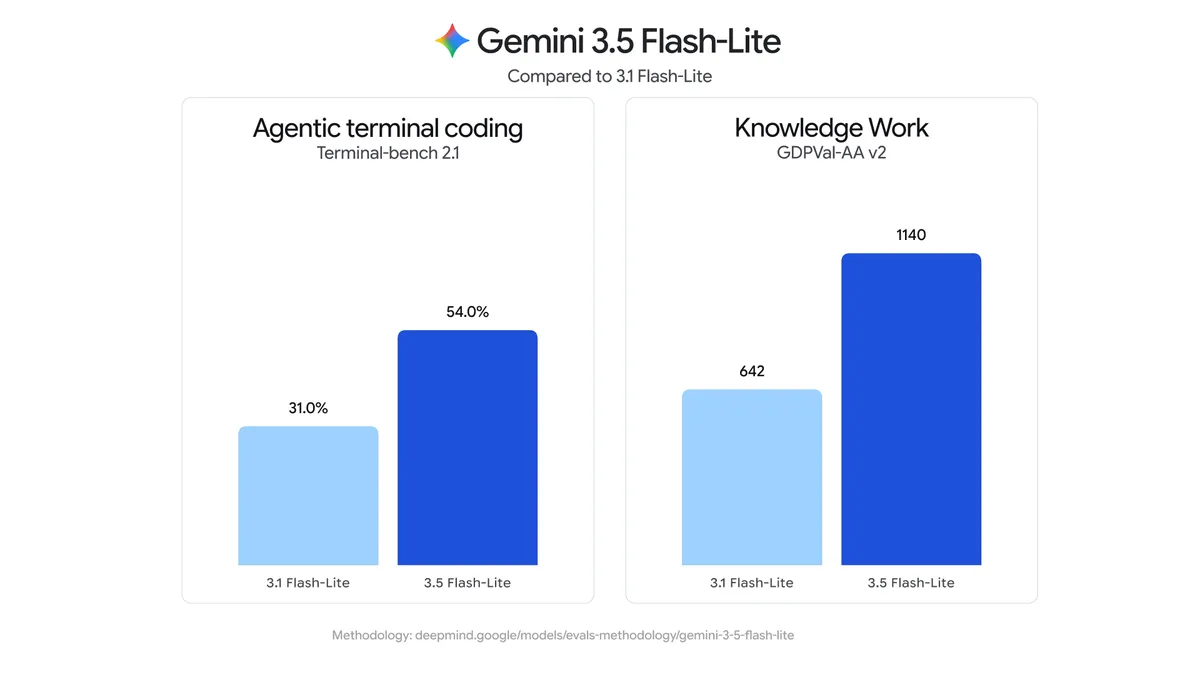
The GDPval-AA v2 number nearly doubling (642 → 1140) is the one to internalize: real-world task execution was exactly where old Lite models fell apart in production agents.
The upset: beating Gemini 3 Flash
More surprising than the generational gain is the cross-tier one. On several agentic and coding evals, 3.5 Flash-Lite outperforms Gemini 3 Flash — a bigger, more expensive model:
| Benchmark | Gemini 3.5 Flash-Lite | Gemini 3 Flash |
|---|---|---|
| SWE-Bench Pro | 54.2% | 49.6% |
| OSWorld-Verified | 74.0% | 65.1% |
If you’re running workloads on 2.5 Flash or 3 Flash today because Lite tiers couldn’t be trusted with agentic work, that assumption is now stale — Flash-Lite is both faster and more capable on these tasks.
Thinking levels: one model, two operating modes
Flash-Lite ships with configurable thinking levels, which effectively make it two products:
- Minimal / low thinking — prioritize latency and cost for high-volume tasks: agentic search, document processing, extraction, classification, routing. This is the 350 tokens/s mode.
- Higher thinking levels — engage deeper reasoning for multi-step subagent workloads, where Flash-Lite acts as a worker under an orchestrator model.
That second mode matches Google’s own demo pattern: 3.6 Flash as the master agent, fleets of 3.5 Flash-Lite subagents doing parallel work (one demo generates 25 web-design concepts simultaneously). Computer use is also a built-in tool on Flash-Lite, so subagents can operate UIs without extra scaffolding. See Google’s Flash-Lite vs 3.5 Flash speed demo (video) for the latency difference on high-volume tasks.
Cost analysis: what scale actually costs
Prices: $0.30/1M input, $2.50/1M output. Here’s an example workload — a document-processing agent handling 1 million documents per month, averaging 3K input tokens and 500 output tokens per document:
| Cost component | Calculation | Monthly cost |
|---|---|---|
| Input tokens | 1M docs × 3K tokens = 3B tokens × $0.30/1M | $900 |
| Output tokens | 1M docs × 500 tokens = 0.5B tokens × $2.50/1M | $1,250 |
| Total on 3.5 Flash-Lite | $2,150 | |
| Same workload on 3.6 Flash ($1.50 / $7.50) | $4,500 + $3,750 | $8,250 |
Roughly a 4× cost difference for a workload Lite handles well — and at 350 tokens/s, the 500-token summary of each document streams out in under 1.5 seconds. The strategy that follows: route the 90% of volume that’s routine to Flash-Lite, escalate the hard 10% to 3.6 Flash.
Decision table: which model for which workload
| Workload | Pick | Why |
|---|---|---|
| Agentic search / RAG at high QPS | 3.5 Flash-Lite (minimal thinking) | 350 tokens/s, lowest cost per query |
| Bulk document processing / extraction | 3.5 Flash-Lite | 4× cheaper than 3.6 Flash; GDM-MRCR v2 72.2% long-context |
| Classification, routing, moderation | 3.5 Flash-Lite (minimal thinking) | Latency-critical, quality headroom to spare |
| Parallel subagent fleets under an orchestrator | 3.5 Flash-Lite (higher thinking) | Purpose-built mode; computer use built in |
| Complex agentic coding (SWE agents) | 3.6 Flash | DeepSWE 49%; higher precision, fewer bad edits |
| ML research workflows | 3.6 Flash | MLE Bench 63.9% vs 49.7% for 3.5 Flash |
| Computer-use agents on hard tasks | 3.6 Flash | OSWorld-Verified 83.0% (vs 74.0% Lite) |
| Multimodal document analysis & report drafting | 3.6 Flash | Validated by Harvey / Hebbia at launch |
| Legacy pipelines still on 3.5 Flash | Migrate up or down | 3.6 Flash for quality, Flash-Lite for volume — see the migration guide |
| Security vulnerability detection & patching | 3.5 Flash Cyber | Only via CodeMender pilot (governments & trusted partners) |
Rule of thumb: default to Flash-Lite and escalate on failure, rather than defaulting to the big model and optimizing later. The failure mode is visible (bad outputs); the waste of over-provisioning is silent.
Where it’s available
3.5 Flash-Lite is live today in the Gemini API (Google AI Studio, Android Studio), the Gemini Enterprise Agent Platform, and the Gemini app — and it’s rolling out inside Google Search, which says a lot about Google’s confidence in its cost profile at planetary scale. Early customers include Ashler, Palo Alto Networks, and Ramp.
Sidebar: 3.5 Flash Cyber and CodeMender
The same launch introduced Gemini 3.5 Flash Cyber — 3.5 Flash fine-tuned for finding and fixing security vulnerabilities. Inside CodeMender, multiple Flash Cyber agents work in parallel and merge their findings into a single combined report, reaching competitive frontier performance on CyberGym. Note the architecture: it’s the same “fleet of efficient specialists” pattern this guide describes, applied to security.
Access is deliberately narrow: a limited-access pilot exclusively for governments and trusted partners via CodeMender, reflecting the dual-use risk of automated vulnerability discovery. Details in our announcement overview.
Bottom line
3.5 Flash-Lite redraws the price-performance frontier for agentic workloads: faster than anything in the 3.5 series, cheaper by roughly 4× than 3.6 Flash, and — for the first time in a Lite model — genuinely trustworthy on agentic benchmarks. Build your routing so that Flash-Lite is the default and 3.6 Flash is the escalation path, and your cost curve will thank you.